
His project had more of an engineering aspect of building design. While his supervisor was the Dean, he had not made a name for himself as an influential conceptual designer. He was recognized for his interest in teaching the technical aspects of architecture. He became a fellow of the Royal Institute of Architecture of Canada in 1974. I searched for buildings designed by Dr. Peter Manning, I could not find any. He was not that kind of architect. Neither was Mart, but he was good at what he did as an architect.
…”Former Professor Larry Richards reflects
on the school’s technical orientation
under Peter Manning…” 50th anniversary Faculty of Architecture 2011
The other two members of his graduate committee were from the Faculty of Engineering. A civil engineering student had made an attempt to run with Mart’s idea for a Master of Engineering for himself, but he was unsuccessful. Seemingly, investigating folded one way curves in architecture had been around since the 1920’s. Mart was doodling one night at his desk during his final undergraduate year, scoring pieces of cardboard making curved shapes and he realized that the cardboard was extremely structurally strong on the folded curve. He might have been building a model for one of his projects; I don’t remember.
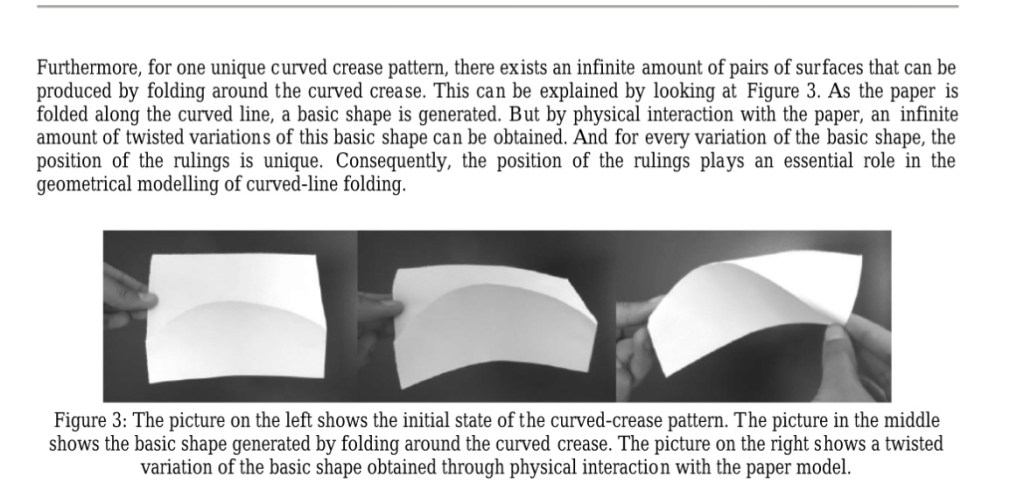
“… a very thin material (like paper) is folded along a curved crease, a 3D shape is obtained by folding (plastic deformation) as well as bending (elastic deformation) of the sheet. This principle is called curved-line folding and has been discovered by students from the Bauhaus in the late 1920’s , as explained in Demaine et al. [1]. Until now, most applications of curved-line folding in architecture only make use of the end state of the folding process. Starting from a flat sheet of material three-dimensional shapes with a geometrical stiffness are obtained, finding applications in sculptures, façade components, furniture etc. Accordingly, the plastic deformation present at the fold lines is permanent and the artefact cannot return to its initial state. However, the authors of this paper believe that curved-line folding can also be used for the design of deployable structures, by use of the elastic deformations that occur when a flat sheet is forced into a curved shape. As one surface area is bent, the forces and moments are transmitted through the curved creases to the adjacent surface areas, which then results in a folding motion…” Aline Vergauwen
The discovery intrigued him. He quickly realized that his friend was going to use his discovery for a research project of his own, so he had to act quickly to get his program started. The National Design Council Scholarship gave an amazing boost to his confidence and our bank account! It had the spending power of about $25k in today’s dollars.
Mart took an opportunity to take part in the field school in England for three weeks duration, with the final year class, and at the beginning of his Masters. Many of the students’ wives went along. It was a great trip for Mart, both professionally and personally. We just thought we couldn’t afford for me to go. And besides I had to work. Passing on that trip likely was a missed bonding opportunity for Mart and me.
However, I did get two really enthusiastic letter’s from Mart’s maternal aunt after he visited her and her husband in Lancashire. She loved him madly, just like so many others!
Here’s one of them.



 Isobelisnecessary